

Best overall for evidence-based personality assessment in 2026: a validated Big Five questionnaire; best for guided handwriting self-discovery: Soulera. Best for signature-focused reflection: signature-only analysis—but no handwriting personality test earns an evidence-backed accuracy winner.
- Handwriting personality test accuracy is not established well enough to name a scientifically proven winner.
- Soulera offers handwriting and signature analysis for self-discovery, not a substitute for validated personality assessment.
- Validated Big Five questionnaires are the stronger choice when evidence matters more than handwriting interpretation.
- Use graphology reports as reflection prompts, not grounds for hiring, diagnosis, or major relationship decisions.
Why this matters
Wanting clarity about your career, relationships, or reactions under pressure is understandable. A handwriting report offers an appealing shortcut: submit something personal and receive an interpretation of yourself. The problem starts when an interpretation becomes a fact simply because it sounds familiar.
Handwriting personality test accuracy means agreement with an independent, credible measure—not how strongly you recognise yourself in a description. A useful reflection exercise and a valid personality assessment are different things. You can enjoy the first without mistaking it for the second.
This 2026 guide ranks assessment approaches by the strength of their evidence and their suitability for different goals. It does not assign accuracy percentages or present an unverified league table of providers.
What makes the best handwriting personality test?
Before choosing a report, judge the method against these criteria:
- Validity: Does published research support the claimed relationship between handwriting features and personality?
- Reliability: Would different assessors, or repeated assessments, reach consistent conclusions?
- Independent comparison: Has the interpretation been checked against an appropriate external measure rather than customer agreement alone?
- Clear boundaries: Does the provider separate self-discovery from diagnosis, recruitment decisions, and predictions about your future?
- Useful feedback: Can you turn the interpretation into a question about your actual behaviour?
- Privacy and consent: Do you understand how your handwriting sample and personal information will be handled?
An assessment does not become accurate because its report is detailed. Credentials, testimonials, and experience also do not replace evidence that the method measures what it claims to measure.
For your 2026 shortlist, give the greatest weight to validity and clear boundaries. Presentation comes later.
Personality assessment options at a glance
| Rank and option | Best for | Standout feature | Key limitation |
|---|---|---|---|
| 1. Validated Big Five questionnaire | Evidence-based personality assessment | Assesses defined personality traits through structured questions | Not a handwriting test; self-report has limitations |
| 2. Soulera handwriting and signature analysis | Guided handwriting self-discovery | Online analysis and self-discovery reports | Graphology is not an established accuracy benchmark |
| 3. Signature-only analysis | Focused reflection on your signature | Keeps the exercise centred on one writing sample | A signature does not establish your personality |
| 4. Automated handwriting personality quizzes | Casual curiosity about handwriting interpretations | Presents interpretations through an automated format | Automation does not establish validity |
The first option is included deliberately. If your real question is which method gives the strongest basis for understanding personality, excluding questionnaires would hide the most useful comparison.
1. Validated Big Five questionnaire: best for evidence-based assessment
A validated Big Five questionnaire assesses broad personality dimensions through structured responses. The model covers openness, conscientiousness, extraversion, agreeableness, and neuroticism, often described in accessible reports as emotional stability at the opposite end.
This is not handwriting analysis. It is the better starting point when you want an assessment grounded in personality research rather than an interpretation of pen strokes.
Big Five questionnaire pros
- Defined constructs: The questionnaire specifies which personality dimensions it assesses.
- Research basis: Established instruments have published development and validation studies.
- Behavioural relevance: Questions ask about tendencies you can compare with everyday experience.
Big Five questionnaire cons
- Self-report bias: Your responses depend on your self-awareness and willingness to answer honestly.
- Instrument differences: A quiz using Big Five language is not automatically a validated questionnaire.
- Limited scope: Trait scores do not explain every decision or replace a clinical assessment.
For a concrete research reference, Christopher Soto and Oliver John published the development and validation of the BFI-2 in Journal of Personality and Social Psychology in 2017. That research concerns a structured personality inventory, not the ability to infer personality from handwriting.
Before using a questionnaire in 2026, check the instrument’s name, its published evidence, and whether the report explains its limits. Avoid treating a trait score as a permanent identity.
Best for: Readers who want an evidence-based starting point for personality assessment.
Verdict: Choose a validated Big Five questionnaire when accuracy is your priority.
2. Soulera handwriting and signature analysis: best for self-discovery
Soulera offers online handwriting and signature analysis, personality insights, and self-discovery reports for individuals and corporate clients. That makes it relevant when you want to explore your writing through a guided interpretation rather than browse disconnected trait lists.
Soulera is best for readers seeking handwriting-based self-discovery, not a validated personality measurement. Treat an interpretation as something to examine against your experience, not something you must accept.
Soulera handwriting analysis pros
- Relevant service: The platform explicitly offers handwriting and signature analysis.
- Self-discovery focus: Its stated offering includes personality insights and self-discovery reports.
- Online format: The service fits readers looking for an online analysis option.
Soulera handwriting analysis cons
- Evidence boundary: Graphology does not provide an established basis for claiming accurate personality measurement.
- Interpretation risk: A description that feels personal can still be broad enough to fit different people.
- Decision limits: A report should not determine employment, medical, financial, or relationship decisions.
Use the report to generate questions you can answer with real examples. If an interpretation suggests that you avoid conflict, examine situations where you spoke up as well as situations where you stayed quiet. A balanced review is more useful than collecting only confirming examples.
Best for: Readers who want guided handwriting reflection and understand its limits.
Verdict: Consider Soulera for self-discovery; skip handwriting analysis when you need a validated assessment.
3. Signature-only analysis: best for focused signature reflection
Signature-only analysis interprets features of your signature rather than a longer handwriting sample. It suits a narrow question: what associations or meanings are being attached to the way you sign?
Keep that question separate from whether the interpretation is true. A signature can be deliberately stylised, abbreviated, or practised, so its appearance should not be treated as direct proof of character.
Signature-only analysis pros
- Focused scope: The exercise centres on a familiar piece of your writing.
- Clear discussion point: You can distinguish your chosen signature style from your ordinary handwriting.
- Reflection value: Interpretations can prompt questions about how you want to present yourself.
Signature-only analysis cons
- Narrow sample: A signature provides less written material than a passage.
- Unsupported inference: Signature size, slant, or decoration does not establish a personality trait.
- Change is not proof: Redesigning a signature does not demonstrate a corresponding personality change.
Ask the analyst to separate what is visible from what is inferred. A description such as an enlarged initial concerns the sample itself; a conclusion about ambition requires evidence beyond the shape of that initial.
Best for: Readers interested specifically in the meaning they attach to their signature.
Verdict: Consider signature-only analysis for focused reflection; skip it as a test of character.
4. Automated handwriting quizzes: best for casual curiosity
Automated handwriting quizzes turn selected writing features or submitted samples into personality descriptions. Their central attraction is the format: you receive an interpretation without a live conversation.
Speed and automation do not answer the accuracy question. A system can apply the same rule consistently even when the rule has no demonstrated relationship with personality.
Automated handwriting quiz pros
- Self-directed format: You can explore the interpretation independently.
- Visible comparison: Feature-based quizzes let you compare a stated handwriting feature with your sample.
- Conversation starter: Results can introduce questions you want to investigate further.
Automated handwriting quiz cons
- Unclear evidence: An automated result is not itself proof of validation.
- Lost context: An interpretation can ignore why the sample was written that way.
- Privacy exposure: Uploading a sample creates a reason to check data-handling terms first.
For any automated option in 2026, ask what outcome was validated and against which independent measure. Recognising handwriting, reading text, or detecting visual features is not the same task as measuring personality.
Best for: Readers approaching handwriting interpretations as casual curiosity.
Verdict: Skip automated handwriting quizzes for consequential decisions.
What the research says about handwriting personality test accuracy
Graphology attempts to infer personality from handwriting. Forensic handwriting examination addresses a different question, such as whether writing samples share an author. Evidence for one task does not validate the other.
Efrat Neter and Gershon Ben-Shakhar’s 1989 meta-analysis in Personnel Psychology examined graphological inference in personnel selection. Its findings do not support using graphology as a dependable hiring assessment; written content also matters when interpreting apparent predictive success.
That distinction matters because an analyst reading a passage encounters more than handwriting. The words can reveal interests, experiences, or self-descriptions. A personality inference drawn from those words is not evidence that letter shapes measured the same trait.
A credible accuracy claim therefore needs a defined target, an independent comparison, and controls for alternative explanations. Testimonials answer whether someone liked or recognised a report. They do not establish measurement accuracy.
How to use a handwriting report without overreading it
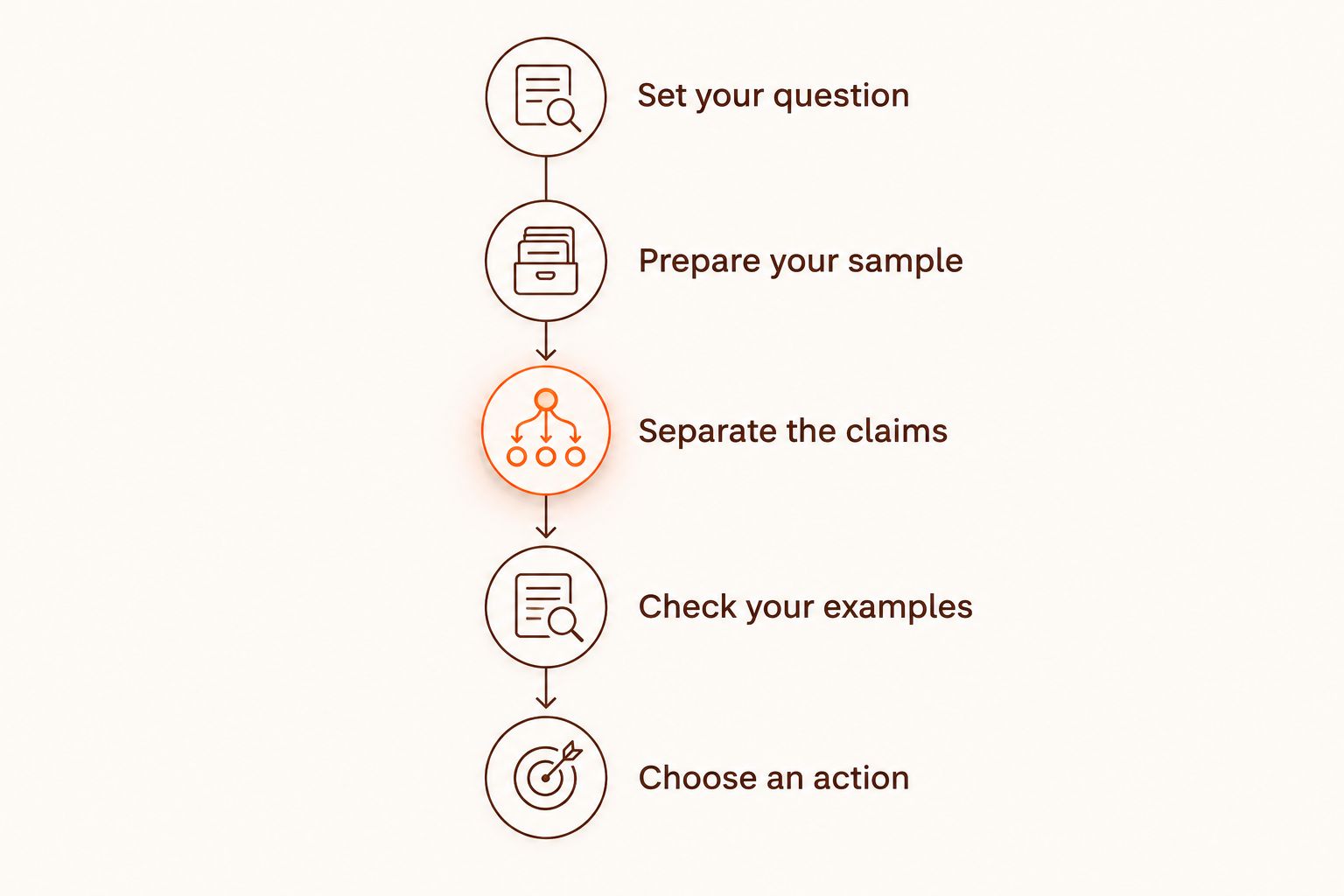
Make the exercise about observation and reflection, not prediction. The following is a suggested routine, not a validated testing protocol.
Set your question
Choose one question about your behaviour, such as how you respond to disagreement. Avoid asking a writing sample to explain your entire personality or predict your future.
Prepare your sample
If the provider gives instructions, follow them. For a personal reflection exercise, write about 150 words naturally rather than trying to make your handwriting look more confident, attractive, or unusual.
Separate the claims
Mark which statements describe visible writing features and which infer personality. This distinction prevents an accurate observation about letter shape from lending unearned credibility to a psychological conclusion.
Check your examples
Compare an interpretation with 3 recent situations. Include evidence against it: if the report describes indecision, look for a situation where you acted decisively rather than dismissing it as an exception.
Choose an action
Spend 10 minutes deciding whether any question from the report deserves practical attention. Choose an observable action, such as expressing a preference clearly, rather than trying to change your personality by changing a letter.
How the options were ranked
The order prioritises published validity, clear assessment boundaries, and suitability for the stated use case. Convenience and personal resonance do not outrank evidence.
This is a decision guide, not a head-to-head accuracy study. The handwriting options occupy different reflection slots; their positions do not imply measured differences in diagnostic or predictive performance.
Which personality assessment should you choose?
Choose a validated questionnaire if you need a defensible personality assessment. Choose handwriting analysis only if you want a reflection exercise and accept that its interpretations are not established measurements.
For a signature-specific question, keep the exercise narrow. For casual curiosity, keep the stakes low. If your concern involves mental health or a major life decision, seek an appropriately qualified professional rather than a handwriting verdict.
FAQ
What's the most accurate handwriting personality test in 2026?
No handwriting personality test has an established evidence base that supports naming it the accuracy winner. If accurate personality assessment is your priority, choose a validated questionnaire rather than graphology.
Can handwriting really reveal my personality?
Handwriting does not provide a scientifically established measure of personality. A graphology interpretation can prompt reflection, but it should not be treated as proof of a trait.
Is Soulera suitable for self-discovery?
Soulera offers online handwriting and signature analysis and self-discovery reports. Approach its handwriting personality insights as reflection prompts rather than a validated psychological assessment.
Is signature analysis more accurate than handwriting analysis?
There is no established basis for declaring signature analysis more accurate as a personality test. A signature is a narrower writing sample, not a shortcut to verified character assessment.
Does an automated handwriting test improve accuracy?
Automation alone does not improve the validity of handwriting-based personality claims. Consistently detecting a visual feature is different from proving that the feature measures personality.
Can employers use handwriting analysis to judge candidates?
Employers should not use graphology to judge candidates' personality or suitability. Job-relevant, validated assessments and structured evaluation provide a more defensible basis for selection.
What should I do if a handwriting report describes me accurately?
Compare the description with specific examples and counterexamples from your life. Recognising yourself in a statement does not establish that handwriting was the source of a valid measurement.
One last thing
A report can describe you convincingly without measuring you accurately. That is the distinction to keep close in 2026: use an interpretation to ask a better question, not to close the question.
Before accepting a trait label, ask what evidence would show it was wrong. If nothing could change the conclusion, treat it as a reflection prompt—not a test result.