

Best overall: evidence-first foundations. Best for employee workshops: reflection-led facilitation. Best for learning the method: supervised handwriting practice. Choose graphology training for HR professionals that explains its limits before teaching interpretations; do not use handwriting to rank job applicants.
- Choose graphology training for HR professionals that separates handwriting observation from unsupported personality claims.
- Evidence-first foundations are the best starting point; recruitment-screening courses are a skip.
- Soulera offers handwriting and signature analysis reports for self-discovery, not an HR training program.
- Keep graphology separate from candidate selection, promotion decisions and mental-health assessment.
Why this matters
Curious about what handwriting reveals? That curiosity belongs in a different conversation from deciding who gets a job. Graphology interprets handwriting as a sign of personality, but it is not an established, scientifically validated method for predicting job performance.
For your 2026 training shortlist, the important distinction is learning about an interpretive practice versus qualifying to assess employees. A certificate in the former does not establish competence in the latter. Attractive course descriptions do not close that gap.
Soulera offers online handwriting, signature and graphology analysis reports for individuals in India seeking self-discovery insights. That is a personal-reflection service, not a reason to use handwriting in recruitment.
This guide ranks training formats by their suitability for HR learning. It is a decision framework for evaluating courses, not a ranking of named providers or an endorsement of their credentials.
What makes the best graphology training for HR professionals
Judge the syllabus before the certificate. Use these criteria to separate useful learning from claims that exceed the method:
- Evidence boundaries: The course distinguishes established findings, graphology interpretations and personal opinion. It does not present handwriting as a validated hiring test.
- Observation discipline: You learn to describe visible features before attaching meaning to them. Observation and interpretation remain separate throughout exercises.
- Employee choice: Participation in any reflection activity is voluntary, with a clear explanation of its purpose and use.
- Feedback quality: A tutor challenges unsupported conclusions rather than rewarding confident personality labels.
- Practical relevance: Exercises suit your learning goal without claiming to predict integrity, competence or future performance.
- Privacy discipline: The syllabus addresses permission, access, storage and deletion of handwriting samples and reports.
The best course teaches you when not to use graphology. Keep that rule at the top of your 2026 shortlist, especially when a provider promotes recruitment applications.
Training formats at a glance
| Training format | Best for | Standout learning focus | Key limitation |
|---|---|---|---|
| Evidence-first foundations | HR professionals new to graphology | Separating observation, interpretation and evidence | Does not qualify you to assess candidates |
| Reflection-led facilitation | Voluntary employee learning sessions | Turning interpretations into open reflection questions | Workplace power dynamics can undermine voluntary participation |
| Supervised handwriting practice | Learners studying graphology methods | Tutor feedback on sample descriptions and interpretations | Tutor agreement does not establish scientific validity |
| Ethics and privacy training | HR teams reviewing proposed activities | Setting boundaries for permission and sample handling | Does not teach handwriting interpretation |
| Recruitment-screening training | Evaluating claims you should reject | Recognising unsupported hiring applications | Handwriting is not a validated basis for selection |
1. Evidence-first foundations: best for responsible HR learning
Evidence-first foundations introduce handwriting features alongside the limits of personality inference. Choose this format to understand graphology terminology without confusing it with occupational assessment. The syllabus should make those boundaries explicit, not leave them to a closing disclaimer.
Look for exercises that ask you to describe spacing, letter formation or slant before discussing an interpretation. A visible feature is an observation; a claim about honesty or leadership is a separate inference. Good teaching makes you notice the difference.
Evidence-first foundations pros:
- Gives you vocabulary for evaluating course and report claims.
- Establishes boundaries before you practise interpretations.
- Encourages questions about evidence rather than deference to authority.
- Fits an exploratory learning goal without promising hiring competence.
Evidence-first foundations cons:
- Does not provide a validated personality assessment qualification.
- Offers less hands-on interpretation than a practice-focused course.
- Requires you to challenge appealing claims rather than accept simple trait rules.
Best for: HR professionals deciding whether graphology has a place in their own learning.
Before enrolling, ask for a sample lesson explaining the difference between an observed writing feature and a personality conclusion. If both appear as equally certain facts, remove the course from your shortlist.
Verdict: Buy only when the syllabus teaches evidence limits explicitly.
2. Reflection-led facilitation: best for voluntary learning sessions
Reflection-led facilitation treats handwriting interpretations as conversation prompts, not findings about an employee. Choose this format only for optional learning activities where participants can disagree, decline or leave without consequences. The facilitator must keep those choices real.
A useful exercise asks whether an interpretation connects with a person's experience. It does not tell that person who they are. Participants remain the authority on their own experiences, and the session does not feed into performance reviews.
Reflection-led facilitation pros:
- Centres the participant's account rather than the facilitator's label.
- Gives you practice asking open questions.
- Creates a clear distinction between reflection and assessment.
- Supports discussion without requiring employees to accept interpretations.
Reflection-led facilitation cons:
- Employees can experience manager-led activities as compulsory.
- Personal disclosures need boundaries and careful handling.
- A reflection session does not establish personality traits or job suitability.
Best for: Facilitators planning genuinely optional self-discovery sessions outside employment decisions.
Ask the provider to demonstrate how a facilitator responds when someone rejects an interpretation. The right response is to accept the disagreement, not explain that the handwriting reveals a hidden truth.
Soulera's handwriting and graphology reports are positioned around individual self-discovery. Keep that purpose separate from workplace assessment when considering this category of service.
Verdict: Hold until participation, confidentiality and non-assessment boundaries are clear.
3. Supervised handwriting practice: best for studying the method
Supervised handwriting practice focuses on applying a course's interpretive framework to writing samples and receiving feedback. It suits learners who want to understand how graphologists reach conclusions. It does not establish that those conclusions accurately describe personality.
Choose exercises that preserve the sample, your initial observations and the tutor's comments. That lets you inspect the reasoning instead of receiving only a final personality description. Feedback should identify unsupported leaps, not merely differences from the tutor's preferred interpretation.
Supervised handwriting practice pros:
- Makes your reasoning visible for review.
- Provides feedback on the difference between description and interpretation.
- Lets you compare how a method handles different samples.
- Helps you recognise when background information influences a conclusion.
Supervised handwriting practice cons:
- Agreement with a tutor is not independent evidence of accuracy.
- Personal context can influence interpretations without being acknowledged.
- Practice does not make handwriting suitable for employment screening.
Best for: Learners who want hands-on familiarity with graphology rather than an HR assessment credential.
As a course-selection exercise, request feedback on 2 practice samples before committing to a longer program. This is a suggested review task, not an industry standard. Use the feedback to judge whether the tutor explains reasoning and acknowledges uncertainty.
Verdict: Buy for method learning only, with no recruitment application.
4. Ethics and privacy training: best for workplace boundaries
Ethics and privacy training addresses how an optional handwriting activity is introduced, what information is collected and who can access it. Choose this format when your responsibility is overseeing a proposed session rather than interpreting samples yourself. It belongs before an activity, not after a complaint.
A suitable syllabus separates participation records from personal reflections. It also addresses what happens when an employee shares sensitive information or asks for their sample to be deleted. Those questions concern responsible handling, not proof that graphology works.
Ethics and privacy training pros:
- Helps define the purpose of an activity before collecting samples.
- Makes access and deletion responsibilities explicit.
- Addresses the difference between an invitation and workplace pressure.
- Keeps personal reflection out of hiring and performance records.
Ethics and privacy training cons:
- Does not teach handwriting analysis techniques.
- Cannot turn an unsupported assessment into a valid one.
- Requires organisation-specific decisions beyond a generic course syllabus.
Best for: HR teams reviewing an optional workshop or external self-discovery service.
For a 2026 workplace proposal, document the purpose, participation choice and information-handling arrangements before inviting employees. Seek appropriate legal or privacy advice for your organisation rather than treating a training certificate as compliance approval.
Verdict: Buy when you need governance skills; pair with clear non-assessment rules.
5. Recruitment-screening training: best treated as a warning sign
Recruitment-screening training teaches or promotes handwriting-based judgements about candidates. Skip this format when it claims to identify honesty, leadership potential, emotional stability or job fit from a writing sample. Those claims exceed what graphology can establish as a selection method.
A course can teach an internally consistent system without proving that the system predicts workplace outcomes. Testimonials, sample reports and certificates do not substitute for evidence supporting the specific employment decision.
Recruitment-screening training pros:
- Studying its claims critically can help you recognise unsupported assessment language.
- Reviewing its examples can expose where observation turns into speculation.
- Comparing its syllabus with evidence-based selection principles clarifies the boundary.
These are reasons to examine the claims, not reasons to use the method.
Recruitment-screening training cons:
- Encourages employment decisions without a validated basis.
- Can attach consequential labels to candidates who cannot challenge the interpretation.
- Distracts from assessing job-relevant skills and experience.
Best for: Recognising course claims to exclude from your shortlist—not conducting recruitment.
For hiring, use job-relevant work samples and structured interviews with consistent scoring criteria. Evaluate any assessment instrument for its intended use rather than assuming that a certificate makes it suitable.
Verdict: Skip for candidate selection, promotion and performance assessment.
How these formats are ranked
The ranking prioritises evidence boundaries, observation discipline, participant choice, feedback, practical relevance and privacy. Evidence-first foundations come first because they establish the limits you need before considering any exercise. Recruitment screening comes last because it turns an interpretive practice into an employment decision tool without a validated basis.
This is a suitability ranking for HR learning in 2026. It does not claim that individual courses have been tested or that any provider delivers the features described.
How to check a course before enrolling
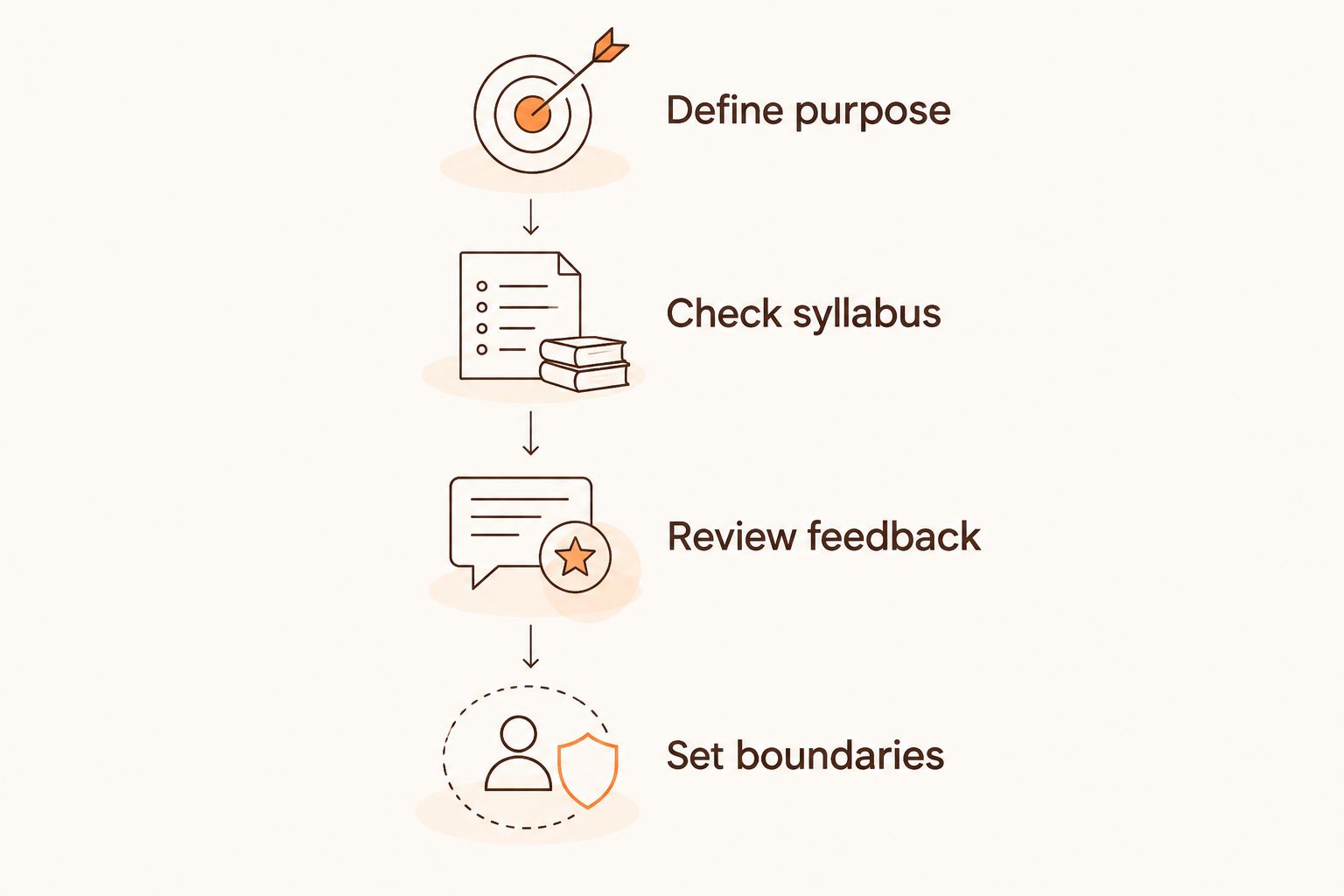
Use this sequence to review a syllabus. Keep the checks in writing so a persuasive sales conversation does not replace the course's actual teaching commitments.
- Define purpose: State whether you want personal learning, method familiarity or facilitation skills. Exclude candidate screening.
- Check syllabus: Look for evidence limits, worked examples, feedback arrangements and privacy topics.
- Review feedback: Ask how tutors respond to unsupported interpretations and participant disagreement.
- Set boundaries: Decide what you will never do with samples or reports in your HR role.
Ask 3 questions during 1 introductory session: What does this course qualify me to do? Which claims have supporting evidence? How are interpretations kept out of employment decisions? These are recommended checks, not provider requirements.
Request written answers. A provider that responds with credentials alone has not answered questions about validity or appropriate use.
Which training format should you choose?
Choose evidence-first foundations as your default in 2026. Add supervised practice only if your goal is understanding graphology's methods, and choose facilitation training only when participation is genuinely optional.
Soulera is best for individuals in India seeking handwriting and signature analysis reports for self-discovery, not HR training. If a personal report is what you want, assess it on that basis rather than expecting a course or professional qualification.
Explore personal handwriting analysis
Review handwriting and signature analysis reports for individual self-discovery, separate from HR assessment.
FAQ
What's the best graphology training for HR professionals in 2026?
Evidence-first foundations are the best starting format for HR professionals learning about graphology. Choose a syllabus that separates observations from interpretations and explicitly excludes handwriting-based hiring decisions.
Can I use graphology training to screen job candidates?
No—graphology is not an established, scientifically validated method for predicting job performance. Use job-relevant selection methods rather than handwriting interpretations to rank applicants.
Does a graphology certificate qualify me to assess employees?
A graphology certificate does not establish competence to conduct validated employee assessments. Examine the qualification's actual scope and the evidence for every proposed assessment use.
Is supervised handwriting practice better than a self-paced course?
Supervised practice adds tutor feedback, but feedback alone does not establish that personality interpretations are accurate. Choose it for understanding the method, not for validating recruitment applications.
Can an HR team run a handwriting self-discovery workshop?
Keep any handwriting reflection workshop optional and separate from employment assessment. Participants must be able to decline interpretations and participation without workplace consequences.
Does Soulera provide graphology training for HR professionals?
Soulera's stated offering is online handwriting, signature and graphology analysis reports for individual self-discovery. Do not treat that service description as an HR training or certification offering.
What should I ask a graphology course provider before enrolling?
Ask what the course qualifies you to do, which claims have supporting evidence and how interpretations are kept out of employment decisions. Review the syllabus and a feedback example before committing.
One last thing
A detailed personality report can feel persuasive without demonstrating that its conclusions are accurate. Detail and validity are different things.
For your 2026 course shortlist, keep this final test: if a lesson teaches you to label an employee before listening to them, skip it. Your next move is to request the syllabus—not the certificate design.