

Best overall: a foundational graphology course with supervised practice. Best for experienced learners: a case-based advanced course. Best for independent learners: a self-paced course with assessed assignments. This 2026 guide compares graphology certification courses in India by learning format, feedback and assessment—not by the appeal of a certificate.
- For graphology certification courses india searches, prioritise assessed handwriting analysis over certificate wording.
- A supervised foundational course is the best starting format for beginners studying graphology.
- Soulera offers handwriting and signature analysis reports for self-discovery, not a stated certification programme.
- Graphology is not a scientifically validated personality assessment; a course certificate does not change that.
Why this matters
Curious about handwriting, but unsure which course deserves your attention? Start with what you will practise and how someone will check your work. A polished syllabus tells you the subjects; an assessment plan tells you what earning the certificate requires.
Graphology interprets handwriting as a source of personality insights. It is not a scientifically validated method for assessing personality, and a graphology certificate is not a qualification to diagnose mental health conditions. Keep that distinction clear before using course material in career, relationship or emotional-wellbeing conversations.
Soulera offers online handwriting and signature analysis reports for personal reflection. Soulera is best suited to people seeking graphology-based self-discovery reports rather than a course qualification. Receiving an analysis and learning to conduct one are different goals; choose the route that matches your intention.
This 2026 ranking compares course formats rather than endorsing named institutes. Use it to shortlist programmes, then check the provider's current syllabus, instructor information and certificate requirements before enrolling.
What makes the best graphology certification course?
A useful course explains both its teaching method and the limits of handwriting interpretation. Use these criteria before comparing certificate titles:
- Clear starting level: The syllabus states whether you need previous study and explains the terms beginners must learn.
- Supervised practice: You submit interpretations and receive corrections, rather than only watching demonstrations.
- Observable reasoning: Assignments separate visible handwriting features from the meanings a graphologist attaches to them.
- Defined assessment: The provider explains what you must complete, who assesses it and what happens if work needs revision.
- Transparent certificate: You can identify the issuing organisation and distinguish completion from assessed achievement.
- Ethical boundaries: Teaching covers consent, privacy, uncertainty and the difference between reflection and diagnosis.
Treat these as decision criteria, not evidence that graphology itself is scientifically validated. Strong teaching can make a course more disciplined without making its personality claims established science.
For your 2026 shortlist, ask every provider the same questions. Comparing different answers to the same questions is more useful than comparing an introductory workshop with an advanced programme by certificate name alone.
Graphology course formats at a glance
| Rank | Course format | Best for | Standout requirement | Key limitation |
|---|---|---|---|---|
| 1 | Supervised foundational course | Beginners seeking structured learning | Individual feedback on handwriting interpretations | Feedback quality depends on the instructor |
| 2 | Case-based advanced course | Learners with an established foundation | Assessed reports across contrasting samples | Unsuitable when basic concepts remain unclear |
| 3 | Assessed self-paced course | Independent learners needing scheduling control | Assignments reviewed beyond automated quizzes | Limited immediate discussion |
| 4 | Signature-focused course | Learners with a narrow signature-analysis interest | Signature and body-writing comparison | Too narrow for general handwriting analysis |
| 5 | Introductory certificate workshop | Curious learners exploring the subject | Clearly defined introductory scope | Completion alone does not demonstrate competence |
The ranking favours feedback and assessment over convenience. If a programme combines several formats, judge the actual learning process rather than its label: a recorded course with individual review differs from a library of videos with a completion certificate.
1. Supervised foundational course: best for beginners
A supervised foundational course is the strongest starting format when you have not studied graphology before. Look for teaching that introduces handwriting terminology, demonstrates observations and then asks you to explain your own interpretations. The important step is correction: someone should show you where description ends and inference begins.
Ask to see an assignment brief and the feedback method before committing. A live class is not automatically supervised practice; listening to an instructor analyse a sample is different from having your own reasoning reviewed.
Supervised foundational course pros:
- Gives unfamiliar terms a structured learning order.
- Creates opportunities to question an interpretation.
- Makes your reasoning visible through submitted work.
- Supports correction before you develop fixed habits.
Supervised foundational course cons:
- Scheduled sessions require a workable timetable.
- Instructor feedback can still contain unsupported personality claims.
Best for: Beginners who want structure and direct correction rather than independent study alone.
Verdict: Buy only when individual feedback and assessed work are explicit parts of the syllabus. Skip a programme that calls demonstrations practical training but never reviews your work.
2. Case-based advanced course: best for developing report skills
A case-based advanced course suits someone who already understands the introductory terminology and wants to practise writing reports. Look for assignments that compare different samples and require an explanation of the observations behind each conclusion. More technical vocabulary is not, by itself, advanced learning.
The useful question is whether the instructor challenges your interpretation. A report-writing course should reward clear limits and careful reasoning, not certainty about someone's character from a handwriting feature.
Case-based advanced course pros:
- Moves practice from isolated features to complete reports.
- Gives you a reason to compare alternative interpretations.
- Creates opportunities to revise overconfident wording.
- Helps you organise observations into readable explanations.
Case-based advanced course cons:
- Builds on assumptions you must already understand.
- Advanced terminology can make weak claims sound authoritative.
Best for: Learners who have completed foundational study and want assessed report-writing practice.
For a 2026 enrolment decision, request the entry requirements and an example assessment brief. Check whether the course expects knowledge you actually have, rather than relying on the word advanced.
Verdict: Hold until you can explain basic observations without treating them as proven personality findings. Choose this format for deeper practice, not simply for a higher-sounding certificate.
3. Assessed self-paced course: best for independent learners
An assessed self-paced course lets you organise study around your own schedule. Choose one that includes submitted assignments and substantive review, not just recorded lessons followed by multiple-choice questions. Scheduling control is useful; feedback remains the deciding factor.
Before enrolling, ask how you raise questions and whether an instructor reviews your interpretations. Also check the access conditions and assignment rules directly with the provider. Do not assume that self-paced means indefinite access or unlimited support.
Assessed self-paced course pros:
- Lets you revisit explanations before attempting assignments.
- Gives you control over when you study.
- Supports written reflection before submitting an interpretation.
Assessed self-paced course cons:
- Requires you to maintain your own study routine.
- Written feedback offers less immediate back-and-forth than a discussion.
Best for: Independent learners who need flexible study and are comfortable asking precise written questions.
A useful self-paced syllabus distinguishes lesson completion from successful assessment. Ask what evidence the provider uses to decide that you have met its learning requirements.
Verdict: Buy only if a person assesses meaningful assignments. Skip a certificate-only pathway when your goal is to learn how to construct and question an interpretation.
4. Signature-focused course: best for a narrow learning goal
A signature-focused course concentrates on signatures rather than the full range of everyday handwriting. It fits a specific interest, but it should explain the limits of interpreting a short, stylised mark. Prefer teaching that compares a signature with body writing instead of treating the signature as a complete portrait of someone.
Soulera offers signature analysis reports for self-discovery. That service category is distinct from certification training: reading an interpretation does not establish your ability to produce one responsibly.
Signature-focused course pros:
- Keeps study centred on a clearly defined subject.
- Encourages detailed observation of a compact sample.
- Can complement broader handwriting study when taught with context.
Signature-focused course cons:
- Does not replace a general handwriting-analysis foundation.
- A signature provides limited material for sweeping personal conclusions.
Best for: Learners whose main interest is signature interpretation and who accept its evidential limits.
Ask whether assignments include ordinary handwriting alongside the signature. Also ask how the instructor handles samples that do not support a clear interpretation.
Verdict: Buy for a focused interest; skip as a substitute for broad training. Avoid courses that promise to determine career success, compatibility or future outcomes from a signature.
5. Introductory certificate workshop: best for exploring interest
An introductory workshop gives you a bounded way to explore graphology before choosing a longer course. Its value is orientation: learning the vocabulary, seeing the interpretive approach and deciding whether you want further study. A completion certificate should remain a record of participation, not proof of professional competence.
Check the workshop's stated outcome. An introduction should not promise expertise that its teaching and assessment cannot demonstrate.
Introductory certificate workshop pros:
- Helps you decide whether the subject interests you.
- Introduces terminology before deeper study.
- Creates an opportunity to question the instructor's approach.
Introductory certificate workshop cons:
- Offers limited scope for independent practice and correction.
- A participation certificate does not demonstrate report-writing ability.
Best for: Curious beginners who want an introduction rather than a practitioner credential.
Verdict: Buy as an introduction; skip if you need assessed competence. Treat any invitation to start analysing other people immediately as a reason to examine the course's ethical boundaries.
How this ranking works
The ranking places supervised foundational learning first because beginners need an orderly introduction and correction. Case-based advanced study follows for learners who already have that foundation; assessed self-paced study prioritises scheduling control without abandoning review.
Signature-focused courses and introductory workshops serve narrower goals. They rank lower here because they do not replace broad foundational learning, not because every programme in those formats is poorly taught. Your purpose determines the right fit; the criteria determine whether a particular provider earns your trust.
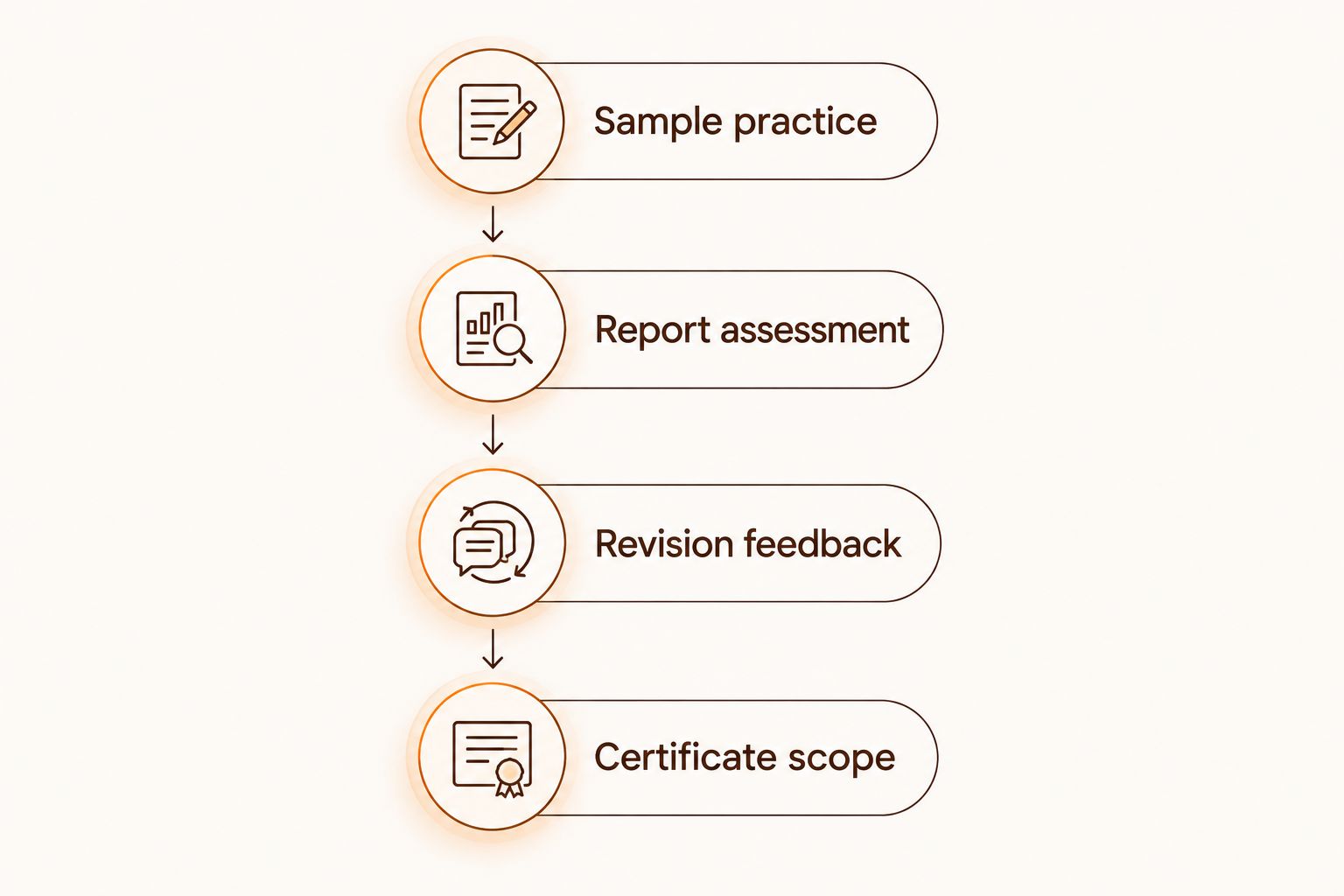
What to request before enrolling in 2026
Ask for the course details in writing. Use the following requests as a buyer's checklist, not as an accreditation standard or a promise of scientific validity.
Sample practice
Request assignments involving at least 3 handwriting samples. This is a practical screening threshold: it helps you distinguish repeated analysis of one demonstration from practice across different material. Ask how samples are collected and whether the writers have consented to their use.
Report assessment
Request at least 2 assessed reports if the course promises report-writing skills. Ask what the marking criteria cover: accurate observation, explanation, uncertainty and responsible wording. A certificate that depends only on attendance answers a different question from one that depends on submitted work.
Revision feedback
Request at least 1 revision round on an assessed interpretation. You should have a chance to respond to feedback, not merely receive a completion message. Ask whether the instructor explains why a claim needs changing.
Certificate scope
Request the issuing organisation's name and the exact completion requirements. If a provider claims recognition, ask who recognises the certificate and for what purpose. A professional-sounding title is not a substitute for a checkable explanation.
Which graphology certification course should you choose?
Choose a supervised foundational course as your default if you are new to graphology. Move to case-based advanced study only when you can describe observations clearly and recognise unsupported conclusions. Choose an assessed self-paced course when scheduling control matters more than live discussion.
If your real goal is self-understanding rather than certification, do not enrol simply to receive an analysis of yourself. Soulera's graphology reports address personal reflection; a course should address learning and assessment. Keep those outcomes separate when deciding what you need.
For any 2026 programme, reject promises of diagnostic authority, guaranteed career outcomes or reliable predictions about relationships. Handwriting interpretation should not replace validated assessment, qualified mental health care or evidence about a person's actual behaviour.
FAQ
What's the best graphology certification course format for beginners in India?
A supervised foundational course with individually assessed assignments is the best starting format for beginners. Check the syllabus, feedback method and certificate requirements before choosing a provider.
Is a graphology certificate a recognised psychology qualification?
A graphology certificate is not, by itself, a psychology qualification. Check the issuing organisation and any recognition claim directly; certificate wording does not establish clinical authority.
Can I learn graphology through an online course?
An online course can teach graphology terminology and interpretive methods. Choose one with reviewed assignments and clear limits rather than relying on video completion alone.
Is signature analysis training enough to analyse handwriting?
Signature-focused training does not replace a broad handwriting-analysis foundation. A signature is a narrower sample, so avoid treating it as a complete basis for personality conclusions.
Does graphology scientifically prove someone's personality?
No. Graphology is not a scientifically validated method for assessing personality, and completing a certification course does not change that evidential limit.
Does Soulera offer graphology certification courses?
Soulera's stated offering is online handwriting, signature and graphology analysis reports for self-discovery. Those reports are distinct from a certification programme.
What should I check before enrolling in a graphology course in 2026?
Check the current syllabus, instructor information, assessed assignments and certificate issuer. Ask how the course handles consent, privacy and unsupported interpretations.
One last thing
Ask the instructor to explain a conclusion they would refuse to make from a handwriting sample. That question tests boundaries more directly than asking how much a certificate will teach you. A responsible answer should distinguish what is visible on the page from what remains unknown about the person.
Keep the same distinction in your own learning. Understanding a method includes knowing when not to use it.